# Getting Started with AWS
#### Contents for Today
* Cloud Computing
* AWS
* Main services
* Security
* Architecture
#### Useful Informations
1. On-premise
: A model where users directly manage Infrastructure, Platform, and Applications
2. Saas (Software as a Service)
: The most common type of Cloud Service where the service provider offers everything from Infrastructure to Software, providing services up to the Application Level
\
## Intro to AWS Cloud
### What is Cloud Computing?
* A type of `Internet based computing` that processes information on other computers connected to the Internet rather than on your own computer
* Served when shared computer manage resources & data are requested
* A model that enables ubiquitous, convenient, on-demand network access to a shared pool of `configurable computer resources` (e.g., networks, servers, storage, applications, and services)
* Can be rapidly provisioned and released with minimal management effort
* `Cloud computing` and `Storage Solutions` provide users and businesses with various capabilities to store and process data in privately-owned data centers or third-party data centers
* Relies on sharing of resources to achieve coherence and economies of scale, similar to a utility over an electricity network

\
### Cloud Computing Services
#### 1. On-premise (Traditional IT)
* Users directly manage Infrastructure, Platform, and Applications
* Large companies build their own **IDC (Internet Data Center)**, while typical cases involve renting space in an IDC, installing physical servers, and managing all Hardware, Operating System, and Server Applications
#### 2. IaaS (Infrastructure as a Service)
* `AWS EC2` is representative
* A service that supports **IT Infrastructure** such as Virtual Servers, Data Storage & Hosting Computers, Networks - a Cloud Model that provides Hardware as a Service
* Manage OS & Applications
#### 3. PaaS (Platform as a Service)
* `AWS Elastic Beanstalk` is representative
* Using Elastic Beanstalk, you can **quickly deploy, operate, and manage** applications in the AWS Cloud without worrying about the **infrastructure** that runs the application!
* Serves Fundamental IaaS + Development Tools & Functions + Deployment
-> They serve pretty much everything you need when you develop & deploy
* Developers only have to write `logic` to connect their application & served services
#### 4. Saas (Software as a Service)
* `Google Apps`, `Office 365` are representative
* The most common type of Cloud Service where the service provider offers everything from Infrastructure to Software
-> Serves **application level service**
* Provided directly to actual users rather than developers
\
## AWS (Amazon Web Service) Cloud Computing
### AWS
> Provides various Infrastructure and Application Services that allow you to run almost all physical computing resources through the Cloud, from Web and mobile Apps, Big data projects, to Social games
* The most secure and reliable Cloud Service
* Provides easy and fast **scalability**
* Provides a platform that can **reduce costs** by paying only for **what you use** without upfront costs or long-term commitments
### Amazon Cloud Service
1. Provides various Application Services including Computing, Storage, Database, Networking, Analytics, Machine Learning, AI, IoT, Security, Application Development, Deploy & Maintenance
2. Not only provides the most **comprehensive range of services**, but also supports the **deepest functionality** in those services
3. `Amazon Elastic Container Service(ECS)`, `Amazon Elastic Container Service for Kubernetes(EKS)` and `AWS Fargate` gives you the most effective way to execute container
4. the most safe and flexible cloud computing environment
5. AWS's core infrastructure is designed to meet the **security requirements** of military, international banks, and other security-critical organizations
6. Each region is built & operated using the same secure hardware/software
* All AWS customers can benefit from the only commercial cloud that supports a supply chain associated with **secure** and **proven** service offerings that are safe enough to handle security-critical workloads
* Supports a deep **cloud security set** including 263 **security**, **compliance** and governance services/main functions
7. Supports 85 **security standards** and **compliance certifications**, and all 116 AWS services that store customer data provide the ability to **encrypt** that data
8. Achieved very rapid innovation in new areas such as `Machine Learning`, `AI`, `IoT`, `Serverless Computing`
9. With AWS, you can leverage the latest technologies to innovate, differentiate, and deliver solutions faster
ex)
* In 2014, launched AWS Lambda, first introducing the event-driven serverless computing space
* With AWS Lambda, developers can run code without provisioning or managing servers, without worrying about provisioning, modification, patch or manage of underlying servers
* Lambda rocks
\
## AWS Main Services
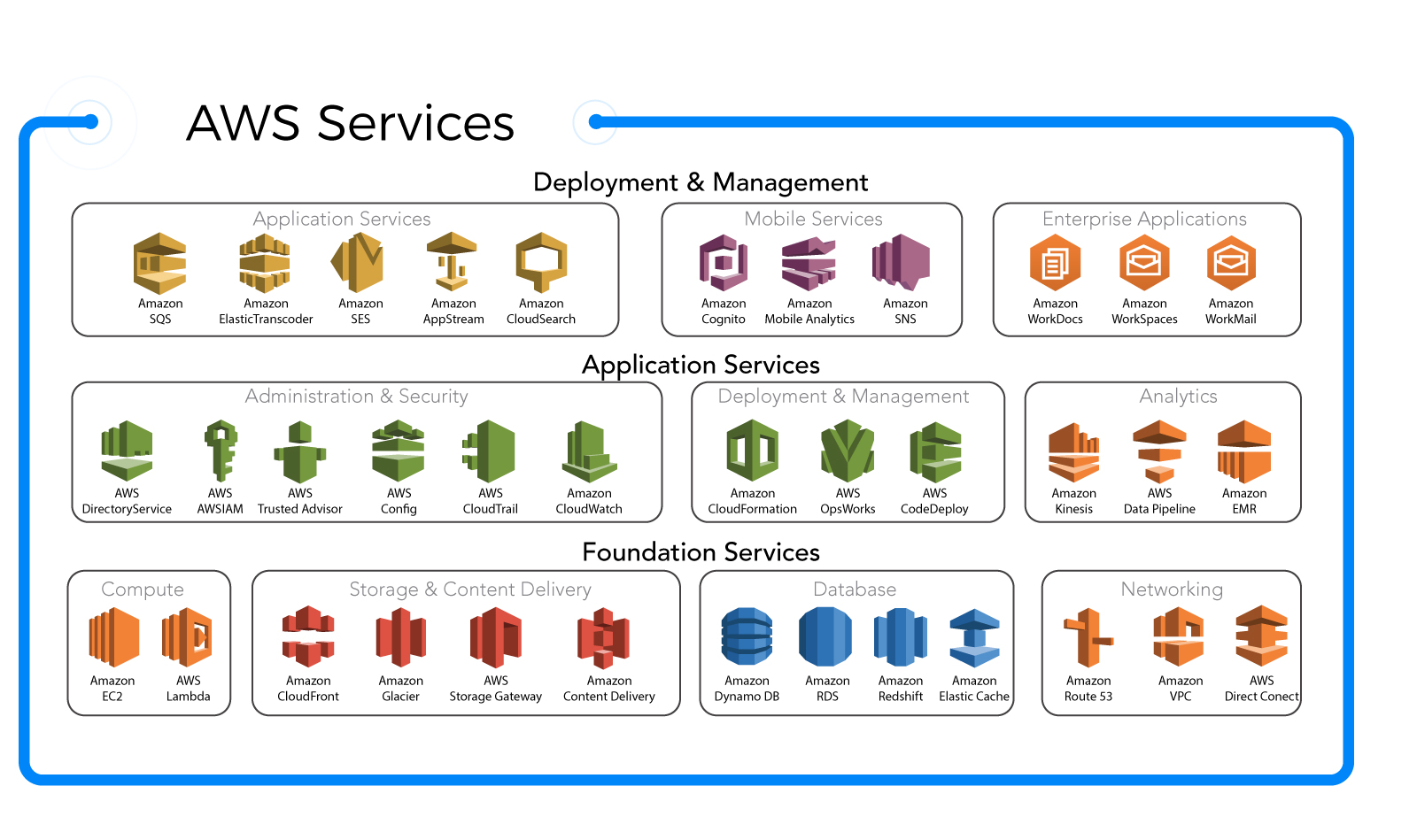
### AWS Security
: Security, identity and compliance products
* AWS's highest priority == `Cloud Security`
* AWS customers can benefit from data center & network architecture built to meet the requirements of the most security-sensitive organizations
### AWS Architecture
* ex) AWS Industrial Predictive Maintenance Machine Learning Model
* Using AWS IoT SiteWise & AWS IoT Analytics with Amazon SNS anomaly detection notifications to create Predictive Maintenance ML models
#### AWS Reference Model Architecture
1. Web Application Hosting
: Build highly scalable and reliable web or mobile applications
2. Content & Media Serving
: Build reliable systems that serve huge amounts of content and media
3. Batch Processing
: Build auto-scalable batch processing systems like video processing pipelines
4. Fault Tolerance and HA
: Build systems with high availability that quickly fail over to new instances when failures occur
5. Large-scale Computing
: Build high-performance computing systems that process Big data
6. Ad Support
: Build highly scalable online advertising serving solutions
7. DR (Disaster Recovery) for Local Applications
: Build cost-effective disaster recovery (DR) solutions for on-premise applications
---
# Agent Instructions: Querying This Documentation
If you need additional information that is not directly available in this page, you can query the documentation dynamically by asking a question.
Perform an HTTP GET request on the current page URL with the `ask` query parameter:
```
GET https://chloe-codes1.gitbook.io/til/aws/aws-101/01_getting_started_with_aws.md?ask=
```
The question should be specific, self-contained, and written in natural language.
The response will contain a direct answer to the question and relevant excerpts and sources from the documentation.
Use this mechanism when the answer is not explicitly present in the current page, you need clarification or additional context, or you want to retrieve related documentation sections.