> For the complete documentation index, see [llms.txt](https://chloe-codes1.gitbook.io/til/llms.txt). Markdown versions of documentation pages are available by appending `.md` to page URLs; this page is available as [Markdown](https://chloe-codes1.gitbook.io/til/web/css/04_grid_system.md).
# Grid System
\
### HTML / CSS Layout
* Layout core
: Stacks from the top left (box model)
* How?
* block
* inline
* Methods to change the layout flow
* float
* position
* flex: flexible box
\
## flex
> Before `flex`, `float` and `position` had to be specified for layout
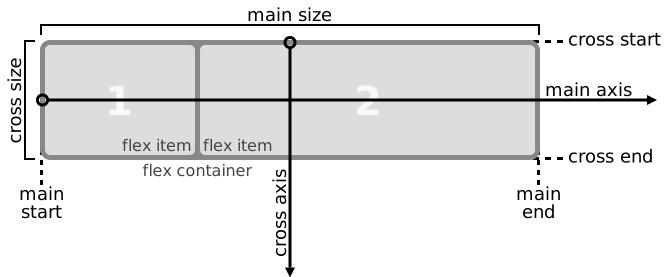
### Key Concepts of flex
* `container`
* `item`
```html
```
* **Axes**
* `main axis`
: Main axis
* Horizontal axis when `flex-direction: row;`
* Vertical axis when `flex-direction: column;`
* Vertical axis *going from bottom to top* when `flex-direction: column-reverse;`
* Horizontal axis *going from right to left* when `flex-direction: row-reverse;`
* `cross axis`
: Cross axis
\
### When Defining flex
1. All items are arranged based on the `main axis`
* The default is `row`
* If set to `row-reverse`, arrangement starts from the right end
2. All `items` are arranged based on row by default
* `flex-direction` : Default set to `row` value
3. All `items` fill the `cross axis`
* They fill the entire height
* Because `align-items: stretch;` is the default value
4. All `items` take up width equal to their own width or content area
* In some cases, it can be smaller than their specified width
* Because `flex-wrap: nowrap` is the default value
* ex) When the total width of all items is less than the container width
5. Each area occupies space equal to its content size / width
* It can be even smaller!
6. All areas fill the cross axis
\
### flex Properties
#### 1. flex-wrap
* Default value `nowrap`
* Forces everything into one line
* `wrap`
* Each item takes its own width and wraps to the next line when there's no room
* Prevents overflow!
* `wrap-reverse`
* Items wrap round to additional lines in reverse
#### 2. flex-grow
> `flex-grow` divides and distributes the remaining width by ratio
* Default value `0`
#### 3. flex-flow
> Shorthand property for `flex-direction` and `flex-wrap`
* Default value `row wrap`
* `row-reverse nowrap`
* `column wrap-reverse`
* `column wrap`
#### 4. justify-content
> Aligns based on the main axis
* Default value: `flex-start`
* `flex-start`
* `flex-end`
* `center`
* `space-around`
* `space-between`
* `space-evenly`
#### 5. align-items
> Aligns based on the cross axis
* `stretch`
: Default value
* `flex-start`
: Top alignment
* `flex-end`
: Bottom alignment
* `baseline`
: items are aligned such as their baselines
* `center`
: Center alignment
#### 6. align-content
> Sets the distribution of space between and around content items along a flexbox's cross-axis or a grid's block axis
*`align-content` has no effect when there is only one line of flex items!*
* Default value: `stretch`
* `flex-start`
* `flex-end`
* `center`
* `space-between`
* `space-around`
#### 7. order
> Can define the order of items
* Default value: `0`
* Can have negative values
#### 8. align-self
> Can specify alignment directly on an item
\
*flex allows `margin-top: auto`!*
\
#### Wrap-up
* justify - main axis
* align - cross axis
* content - multiple lines
* items - single line
* self - individual element